Access to education remains a necessary but unattainable goal for millions around the world. Global statistics are clear on the need for educational access, particularly among girls: nearly 4 in 10 adolescent girls and young women won’t complete secondary school, while approximately 50 million girls today cannot read or write a sentence.
In Afghanistan, the barriers to education for girls can feel particularly complex—and entrenched—especially with reclamation of the government by the Taliban in 2021 and the ongoing conflict in the Middle East.
In 2001, of the 1.2 million Afghans attending school, fewer than 50,000 were girls—two years later, girls accounted for just six percent of Afghan students. And when girls and young women have pursued their education, they’ve done so at unimaginable risk.
In the Taliban-controlled Afghanistan of 1996, girls were prohibited from continuing their education past the age of eight, forcing women’s education underground and punishing it with violence. The consequences were real, and yet girls risked their lives or their health for an education. In 2008, while on her morning walk to school, this exact violence changed Shamsia Hussaini’s life forever.
Walking on foot to the Mirwais Mena School for Girls, on the outskirts of Kandahar, Shamsia and a group of her friends were violently attacked—and sprayed with acid. These actions—designed to spread fear and keep girls and young women from seeking an education—impact entire communities and put countless people at risk.
Shamsia’s story caught the attention of Pulitzer Prize winning journalist Dexter Wilkins, who covered this issue in a feature article in the New York Times. He was so moved by her story that he helped to establish a fund to purchase a bus to take her and her peers to school safely.
In 2013, Dexter contacted Greater Good Charities with a question: could we take over the fund and continue its operation? The answer was yes. And quickly, we determined that the need was so great that more buses were needed.
Thanks to matching funds from the Klintworth Family Foundation in 2014, we worked to raise enough funds to purchase two additional buses and fund their operation until 2020. Ultimately, we provided over 300,000 safe rides to school for thousands of students. For the safety of the students, it isn’t a project we publicized much, but it remains one of the most impactful efforts Greater Good Charities has ever undertaken.
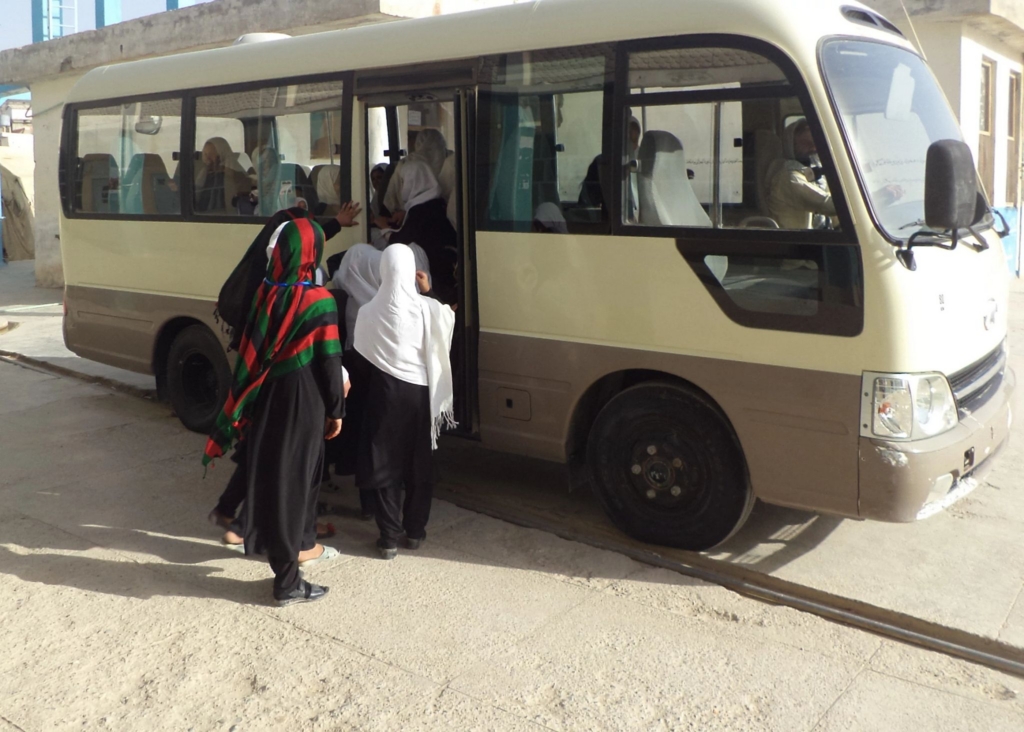
And what about Shamsia? After Shamsia Hussaini was attacked on that morning walk to school in 2008, she did more than recover—she returned to Mirwais Mena as an educator.
“[This bus] protects girls from similar attacks,” Shamsia told us, now a teacher. “Insecurity is a big challenge for us. We are suffering from people who dislike girls’ education, and the Safe Ride program is one of the safest ways to avoid such incidents in the future.”
Shamsia’s is one story, but it is demonstrative for the girls and young women Shamsia now teaches: of the value—and the stakes—of education, and what it means to show true strength and resilience.
Growth and challenges
In the years following the Taliban’s first rule of Afghanistan (1996-2001), the progress made in education reform has been immense—it still serves as a reminder to the people of Afghanistan for education’s potential, regardless of who is in control.
The 1.2 million Afghan student enrollments of 2001 rose to 8.2 million by 2013, including 3.2 million girls. By 2017, 39% of girls in Afghanistan were attending school—over six times the 2003 enrollment rate. In the two decades that followed 2001, Afghanistan’s literacy rate rose from 8% to 43%.
In the aftermath of the Taliban’s seizure of governmental control in 2021, the program was no longer able to be ran. While initial Taliban education policies toward girls and women gave optimism to many, they were soon altered to enact greater limitations on girls’ access to education—Afghanistan is now the world’s only nation to restrict girls from going to school past the age of twelve.
While Greater Good Charities has been forced to take a step back, we continue to look for solutions to support girls all over the world, providing simple solutions to barriers to an education.