In fall 2024, Hurricanes Helene and Milton struck the southeastern United States just weeks apart.
In fall 2024, Hurricanes Helene and Milton struck the southeastern United States just weeks apart, battering communities already vulnerable to disasters and the impacts of climate change. The storms cost dozens of lives, destroyed countless homes, damaged numerous animal shelters, and left communities in chaos.
We watched with dread as Helene, then Milton, barreled through places we have worked for years—communities several of our own staff members call home. True to form, our teams harnessed heartbreak into action, setting the largest disaster response in our history into motion.
Our field operations team was on the ground with pre-positioned aid before the storm hit. Alongside the SPCA of Florida, they began moving shelter animals out of the path of the hurricane 24 hours prior to landfall.
Within days of the storm, we were moving human and animal aid to communities in need; within weeks, our trucks and teams reached five states by road and air, moving over 2,800 tons of food, water, hygiene items, cleaning supplies, and pet essentials into affected communities.
A Cascade of Crises—and a Comprehensive Response
When the storms hit, communities were thrown into chaos. Homes were damaged and destroyed, leaving many without shelter and resources, and the hurricane winds and flooding wreaked havoc on infrastructure, making it difficult for residents to access essential services and support.
This called for a systematic approach to address interconnected vulnerabilities across the region.
Our relief operations always start by listening. Alongside our local partners and emergency agencies, we mapped critical needs on the ground. Our analysis identified three critical gaps: immediate survival needs, animal welfare capacity, and ecological system stability. From there, we deployed massive quantities of humanitarian and animal aid from Greater Good Charities regional hubs, sent in staff from across the country, and activated vital in-kind partners.
We dispatched critical supplies to multiple hard-hit states in the wake of the storms. In Florida, trucks of bleach were delivered to food banks to support safe food distribution. In Tennessee and Georgia, pallets of pet supplies reached shelters and rescue organizations. South Carolina animal sanctuaries received truckloads of pet food. And in North Carolina, we delivered diapers and infant formula, gasoline for stranded families, and generators to keep medications cold.
Yet perhaps nowhere were things worse than in overlooked communities.
Adam Cotton from the Asheville Humane Society— a longstanding Greater Good Charities partner—saw it firsthand when visiting lower income neighborhoods. “We walked in and found two 12-packs of water, and that was it,” said Cotton. “The rest of the community had really left that neighborhood in the cold. One call to Greater Good Charities and within hours, a semi-truck delivered pet food, human hygiene products, and a trailer full of diapers.”
Animal Welfare: Addressing Capacity Constraints
Shelters across the region were overwhelmed as Hurricane Helene triggered flooding, power outages, and road closures that cut off access to care. Already at or near capacity, they struggled to house a surge of displaced animals. With transport networks disrupted and critical infrastructure lost, many operated in isolation, relying on limited resources to meet growing needs.
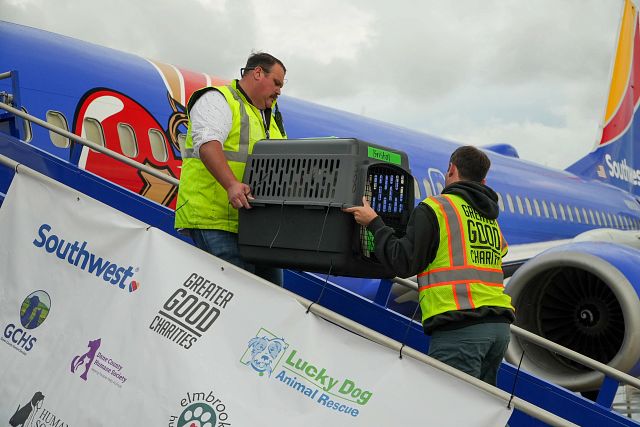
Working with Southwest Airlines, we organized an emergency flight that got over 270 shelter pets to safety in the Midwest and Pacific Northwest. This wasn’t just about moving animals—it was about making room for the displaced pets still arriving and giving families a real chance to find their missing companions.
At the same time, we tackled the basics shelters needed. Thanks to partners like PetSmart Charities, which stepped up with a $100,000 grant, and Purina, which provided $25,000 plus supplies, we dispatched food and essentials directly where they were needed most. We sent 16,500 pounds of pet food from Mars and Champion Pet Food to our Florida partners, delivered pallets of Tidy Cat litter to Nashville Humane Association, and got disease testing kits from pet healthcare company IDEXX to the right hands.
The goal was simple: to get the right aid to the right places—no matter how hard to reach— as quickly as possible. When we worked with Lucky Dog Animal Rescue to evacuate 146 animals from Tennessee’s flood-damaged Washington County Johnson City Animal Shelter or supported distribution hubs like Asheville Humane Society serving their communities, we made sure what we provided was what was actually needed—for animals and the people already doing incredible work under impossible circumstances.
Wildlife centers also found themselves on the front lines of ecological devastation. “It just hit us—it looked like a war zone,” said Mary from Wild for Life, a wildlife center in North Carolina. “We couldn’t get out of our driveway. No electricity. No water. Then we became quite inundated with injured birds.” Greater Good Charities teams delivered clean water, cleaning supplies, and towels so these centers could continue their lifesaving work.
Pollinator Systems: Preventing Ecosystem Collapse
The hurricanes also ravaged entire ecological systems. Hurricanes Helene and Milton together destroyed an estimated 95,000 beehives, threatening billions of bees with starvation as forage and habitat were wiped out.
We knew what was at stake. One in three bites of food in the U.S. depends on pollinators, billions of which overwinter in the Southeast. Without immediate action, the crisis would ripple, impacting food supplies and economies far beyond the storm zone.
So, we leaned into partnerships with Mann Lake—one of the nation’s largest beekeeping suppliers, Cargill, and the Florida State Beekeepers Association. Working shoulder-to-shoulder, we delivered more than 41,000 gallons of syrup and nearly 40,000 pounds of protein-rich pollen substitute at emergency feeding events across Florida, Georgia, South Carolina, and the Carolinas.
These combined efforts helped stave off starvation for billions of pollinators while natural forage recovered and helped beekeepers sustain their livelihoods.
Our pollinator work in the region continues today, as does our preparedness with regional hubs stocked and hundreds of substitute pollen “totes” sitting on standby.
Staying As Long as We are Needed
Totaling more than $10 million in aid, our response to Helene and Milton became Greater Good Charities’ largest-ever disaster and recovery operation, a testament to what listening to communities, addressing problems with ingenuity, and adapting can achieve.
Every step, from airlifting animals to safety with our partner Southwest Airlines to delivering diapers or distributing gallons of bee syrup, is a reminder of our comprehensive approach: when disaster strikes, we show up for every part of the community.
And we’ll keep showing up—side-by-side with partners like Mann Lake, Cargill, and hundreds of local organizations—until families, pets, pollinators, and the ecosystems we all depend on are safe and thriving again.